A Decade of PWI Central Java Journalism School with FH Unissula: Preparing Media-Literate Graduates
بكالوريوس القانون UNISSULA
The partnership between the PWI Central Java Journalism School and the Faculty of Law, Universitas Islam Sultan Agung Semarang (FH Unissula), has entered its tenth year — a full decade.
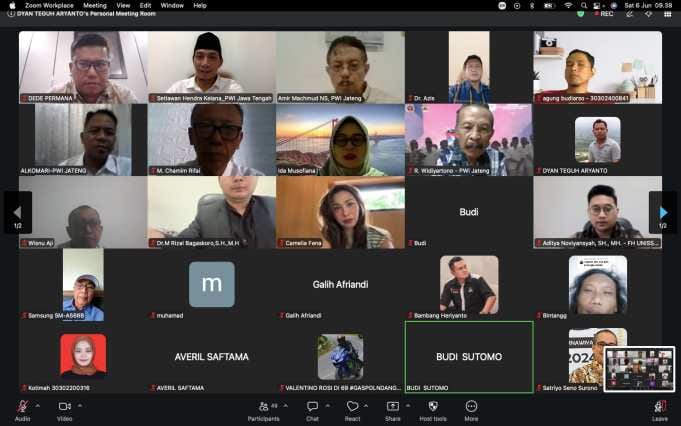
The 27th cohort of the PWI Central Java – FH Unissula Journalism School was held on Saturday, 6 June 2026. Conducted online, it was attended by 91 participants: students from every pathway — the regular class, the executive class for working professionals, and the Recognition of Prior Learning (RPL) programme — all of whom are about to graduate.
The 27th cohort was opened by Vice Dean I of FH Unissula, Dr Ida Musofiana SH MH, representing the Dean, Prof Dr Jawade Hafidz SH MH. She was accompanied by Vice Dean II Dr Muhammad Ngazis SH MH, Head of the Bachelor of Law Study Programme Dr M Rizal Bagaskoro SH MH, and Programme Secretary Aditya Noviansyah SH MH.
PWI Central Java was represented by its Chair, Setiawan Hendra Kelana; the Chair of the PWI Central Java Honorary Council and lead speaker, Amir Machmud NS; Deputy Chair for Education Alkomari; and further speakers including R Widiyartono, Zaenal Muttaqin, and Budi Sutomo.
Setiawan Hendra Kelana said the 27th cohort reflects a shared commitment between PWI and FH Unissula. The programme is designed specifically to equip future law graduates with media literacy and professional writing skills.
“This 27th cohort is a strong marker. PWI and FH Unissula are on the same wavelength: by the time they graduate and start work, participants will understand press law, the code of ethics, article writing, and media convergence in an era vulnerable to hoaxes and doxing. The ability to write legal opinions will forge them into capable, respected lawyers,” he said.
Ten Years On
In her remarks, Vice Dean I Dr Ida Musofiana expressed deep appreciation for the close relationship built with PWI Central Java since 2016. Reaching a 27th cohort over ten years, she noted, is no small feat.
“The number 27 is a symbol of maturity — this programme has been tested and refined. Its foundations are solid. Started in 2016, a decade is no small measure of consistency,” Ida said.
She added that, as part of the social sciences and humanities, law students must stay attuned to a civilisation moving rapidly from Industry 4.0 towards Society 5.0. In this digital era, leaps in information technology often trigger social friction and waves of disinformation.
The faculty stressed that ethical writing is an essential skill for future law graduates, whether they go on to become academics, legal practitioners (judges, prosecutors, advocates), or community advocates.
Original and Accurate
Through the Journalism School with PWI, FH Unissula wants to ensure that every piece of academic writing produced by its students is highly original and accurate — defensible both morally and legally.
“FH Unissula graduates are expected to be highly competent, and writing is one of those competencies. With direct guidance from PWI, we hope students develop strong integrity and ethics, producing work that is high-quality, objective, and accountable to the public. This is the crucible in which FH Unissula students sharpen their journalistic skills,” Ida said.
The sessions were substantive. Amir Machmud NS, Chair of the PWI Central Java Honorary Council, examined press law and the journalistic code of ethics in depth. He issued a strong warning about "journalistic anarchy" — information produced without the standards of the Press Law and the code of ethics, which can destroy the reputation of a person or an institution in an instant.
Amir also addressed artificial intelligence with reference to Press Council Regulation No. 1/2025. “Remember, AI is only an assistant, not a replacement. Moral control and accuracy remain in the hands of the journalist, for the sake of credibility,” he said.
Zaenal Muttaqin unpacked media convergence. In an era where text, images, audio, and video merge on a single digital platform, he shared how media organisations must adapt by strengthening human resources and creating content that holds public attention.
R Widiyartono, an assessor for the Journalist Competency Test (UKW), covered engaging writing: how to hunt for fresh ideas, craft headlines with impact, and construct a lead that holds the reader to the final sentence.
Closing the class, Budi Sutomo delivered material crucial for future legal professionals: the anatomy of a legal opinion. He reminded participants that much of an advocate's and legal consultant's work is spent at the desk drafting legal opinions.
“Mastery of theory and regulation, and sharpness in interpreting each provision of the law, are what a legal professional's reputation rests on. A wrong analysis puts your good name at stake,” Budi concluded.