
Unissula Law Students Study the Specific Powers of the Constitutional Court
UNISSULA 法律学士
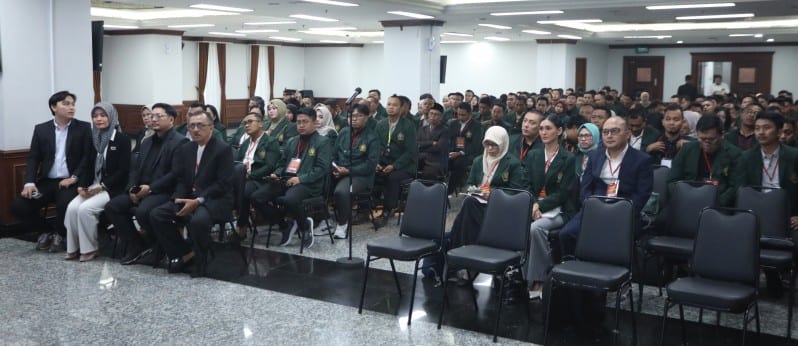
A group of 160 students from the Faculty of Law, Universitas Islam Sultan Agung (FH Unissula) Semarang, visited the Constitutional Court for a field study on Monday, 4 August 2025. Court Legal Analyst Arinta Sulistiyo welcomed the group in the Ground Floor Hall of Building 1. In a presentation titled “The Constitutional Court”, Tiyo explained why the Constitutional Court of the Republic of Indonesia was established.
Long before the 1998 reform era, many statutes were problematic and there was no mechanism for constitutional review. A President had once been impeached for political reasons, and conflicts between state institutions were frequently settled only under presidential authority. At that time there was also no clear forum for resolving election disputes, and the dissolution of political parties went through the Supreme Court under an unclear mechanism.
Tiyo explained that the Court's powers are set out in Article 24C paragraphs (1) and (2) of the 1945 Constitution, Law 48/2009 on Judicial Power, and Law 24/2003 as last amended by Law 7/2020 on the Constitutional Court. These powers cover reviewing statutes against the Constitution; deciding disputes over the powers of state institutions conferred by the 1945 Constitution; deciding the dissolution of political parties; and deciding disputes over general election results — together with the obligation to rule on the House of Representatives' opinion regarding impeachment.
After the presentation, students raised questions enthusiastically. Adrian Kurnia asked about the overlap between the powers of the Supreme Court and the Constitutional Court in judicial review. Tiyo explained that two institutions have authority to review legal norms in Indonesia, but each has its own specific remit.
“The distinction is that the Constitutional Court reviews only the norms contained in statutes, measured against the Constitution. If a statutory norm is under review at the Constitutional Court and the Supreme Court receives a copy, any review of subordinate regulations already under way at the Supreme Court is suspended until the Constitutional Court issues its decision,” Tiyo said.
Source: mkri.id — Author: Sri Pujianti